A Little About Me
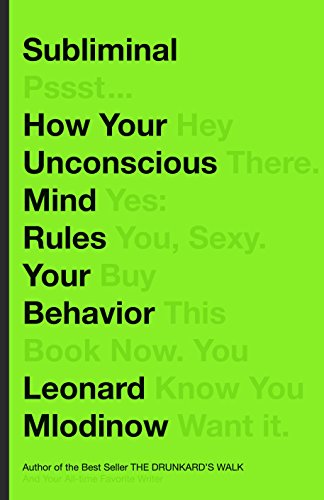
My name is Kayla LePage and I am in my second semester of community college. My plan is to eventually transfer to a University specific toward my career of interest in Game Development. Although I’m not yet certain on a major, psychology will most likely be my minor. I’ve always been fascinated by psychology, Cognitive Psych has only been my second Psych class and I’m curious to learn even more about the differences between certain areas of psychology. For this Book Blog assignment I had trouble picking a title because they all sounded so interesting, I ended up reading Subliminal: How the Unconscious Mind Rules your Behavior by Leonard Mlodinow. I think about Unconscious behaviors very often, and I’m curious to know how the subliminal effects us so much without us knowing or realizing. I would like to give actual reasoning behind these unconscious behaviors, good and bad, and to understand them to possibly improve myself and help others figure out why they do things they wouldn’t expect of themselves or others.

About the Author
The author of this book is Leonard Mlodinow, an American theoretical physicist, screenwriter and author. Other than Subliminal: How Your Unconscious Mind Rules Your Behavior, he is the author of many other best selling books, including, The Grand Design which he co-authored with with Steven Hawking, The Drunkard’s Walk, and How Randomness Rules Our Lives. Subliminal even ranked #1 on the New York Times best seller list. Dr. Mlodinow started his college education at Brandeis University Waltham Massachusetts in 1972, but dropped out in 1973 at the beginning of the Yom Kippur War. During his time he traveled to Israel to work on a kibbutz, this is where he indulged himself in reading some of Richard Feynman’s books and gained his passion for physics. Once continuing school, he graduated in 1976 with majors in chemistry, math, and physics. A few years later in 1981, he received his PHD in theoretical physics from the university of California at Berkeley. After which, Dr. Mlodinow along with Nikos Papanicolaou, a fellow physicist, developed a new method of approximation to “solve a problem in infinite dimensions, and then calculate correction to account for the fact that we live in only three” (Leonard Mlodinow Biography). On Top of this, he along with Mark Hillery, a fellow author, even corrected a quantum theory on electromagnetic interactions while teaching at the Max-Planck-Institute for physics and astrophysics in Munich, Germany. Eventually physics research became more of a hobby for Dr. Mlodinow, because upon moving to Los Angeles, he became occupied with writing screen plays. After the screenplays, his interest then moved to computer gaming, where he found even more success, obtaining multiple awards for his work in this field. He became head of Scholastic Software and while here wrote his first science books. These books kicked off his teaching career when in 2005 he became a professor at Caltech Faculty. He continued his writing here, but eventually left to become a full time writer in 2013. Subliminal, How your Unconscious Mind Rules Your Behavior was published in 2012, the year before he left.
The Main Idea
The main idea of the book is to bring awareness to how influential the subliminal and unconscious is to our behavior and decision making. Cognitive psychology is the study of human mental processes such as thinking, perceiving, and problem solving and their influence on behavior. The book mainly focuses on our unconscious mental processes altering certain behaviors and decision making. Things like bias and expectation, and even deeper brain functioning like memory and the senses are explained and defined how they can be subliminally influenced.
One of my favorite examples is on the topic of stereotypes and discrimination. Dr. Mlodinow argues that discrimination is an unconscious, unavoidable cognitive mental process, but back in the 1980s, “many psychologists viewed discrimination as a conscious and intentional behavior” (Mlodinow, 2013). The book further backs up this argument, bringing up a popular research tool called the “Implicit Association Test” or IAT which measures an individual’s assigned traits to a social category. IAT results prove that evaluations we have of others that we feel are rational are actually much more unconsciously effected.
A large portion of the book is heavily dedicated to the idea of social unconscious. Social interaction is vital to our species continued existence, and the social unconscious is what helps maintain and form our social world. Without it, we’d fall apart as not only a species, but as individuals. Subliminal signaling such as eye contact, body language, or even clothing choice act as communication without words. We can establish our dominance, submissiveness, or equality through eye contact ratio with one another, people can be either attracted or repelled by us through certain body movements and patterns, and we can completely change how others interact with us based on our social status by simply dressing accordingly. We’ve been able to discover these and many more astonishing subliminal influences through a multitude of social experiments.
Book Analysis
The subject of the book, like most branches of psychology, is still actively being researched. However, it is currently well established enough to teach many solid points.The way our unconscious selves interacts with our society in particular is groundbreaking to our previous belief that we had total control over our actions and behaviors when in social settings. A simple conversation between friends about an upcoming exam only scratches the surface on the amount of communication happening between the two. If we only relied on what we consciously hear, we would miss important details. Such as if one says they’ve spent weeks in preparation, relying on just those words we assume they are well prepared and confident in acing the exam. But with subliminal communication, their fidgeting hands or stuttering indicate they are actually quite nervous.
Dr. Mlodinow approaches this topic in a professional, well established way that is easy to understand thanks to his relatable examples and termanology. So far one could compare the topic of each chapter to their own lives whether it’s something they themselves experience or have noticed of others. The first section of the book covers the brain functions involved with our unconscious. Such as when we remember things that never happened, or how blocking pain receptors in the brain can relieve social pain from rejection, exclusion, or isolation. The explanations go beyond locations and we are shown the importance of first understanding what our brain does with unconscious data. Each discovery in the following sections was accompanied by a corresponding research method applied to get the results. So one can see how a subliminally influenced behavior is possible. All explanation and evidence was factual and logical, and the intriguing readability resulted effortless furthered knowledge of the subject.
I remember coming across many topics in the reading that we later covered in the course, such as the topic of remembering and forgetting. However there were a few things in the reading not covered that I would of liked to further get into. Such as how our behaviors from the past reflect our behaviors of the present. The topic was brought up as example a few times in the course, but never really delved into. In the book, our unconscious social behaviors are mainly linked to our way of life in the past when first developing a society. So many if not all of the topics were linked back to our evolution, a highly intriguing subject to me.
Overall, I’d say the targeted audience for this reading would be anyone looking to further their knowledge of the unconscious. Perhaps those studying the subject of psychology or sociology.
My Reaction
At first I didn’t know what to think about cognitive psychology, it’s only been my second spy course other than introduction. I had originally grouped all psychology under one category, which is what makes a human tick. But I soon understood the difference and the reading, being an outside contributor, helped greatly with the distinction. We have all kinds of mental processes going on in our heads and these processes applied to what we perceive through our senses are what create the reality we experience. Once that reality is created, we feel, behave, problem, solve, and think accordingly. Our realities are different from other individual’s realities, and this clash in perspectives are what elicit these behavioral responses.
I wasn’t sure what to expect when getting this book. Most of the time when people hear the term “Subliminal” they think of hypnotic messages in advertising or hidden images in television meant to influence our beliefs or desire to purchase a product. This book goes far beyond that and tackles how basic interactions in our everyday lives are the result of subliminal communication between human beings. Since reading it, I’ve noticed I tend to pay more attention to these subliminal messages in my own and other’s body language, or eye contact. I’ve already recommended the book to a fellow friend studying in psychology, someone I constantly bombard with my excitement in noticing unconscious behavior in our conversations.
References
Leonard Mlodinow Biography. (n.d.). Retrieved from http://leonardmlodinow.com/leonard-mlodinow-biography/
Mlodinow, L. (2013). Subliminal: How your Unconscious Mind Rules your Behavior. New York: Vintage Books.

 Kayla's Book Blog